

 JOIN
JOINSome drivers are fastest when they are chasing someone.
Put a kart in front of them and everything sharpens. The braking points feel clearer. The speed comes easier. The lap time appears.
Then they overtake. Or they end up alone. Or they finally get to the lead.
And suddenly the pace drops.
Not because they forgot how to drive. Not because they cannot handle pressure. But because the reference they were using has disappeared.

Your pace may be borrowed
This is one of the easiest habits to develop in karting because it often starts as something positive.
You follow a faster driver. You copy their rhythm. You learn where they brake, how early they rotate, how much speed they carry. You get dragged up to a better level quickly.
That can be useful. But it can also hide a problem.
If your best laps only appear when someone else is showing you the limit, then part of your pace is not fully yours yet. You are using their references more than your own.
Why it becomes a race problem
This does not only matter in practice. It shows up when races start to matter most.
A driver fights forward, finally gets clear air, and then loses two tenths a lap. Sometimes more. The pack they just escaped from starts coming back. The driver who should be breaking away becomes the one being hunted.
Now every race becomes harder than it needs to be. Instead of turning clean air into control, they are forced into more defending, more pressure, more mistakes, and bigger fights.
The hidden cost
Losing two tenths alone does not sound dramatic for one lap. Over five laps, it is a full second. In a race, that can be the difference between escaping and being swallowed by the pack.
The driver ahead feeds you information
When another kart is in front, you get constant feedback without thinking about it.
You can see whether you are gaining or losing. You can sense if you braked too early. You notice if they carry more speed. Every corner gives you a comparison.
When you are alone, that comparison disappears. The track feels quieter. Your focus can soften. And if you have not built your own internal references, the limit becomes harder to find.
This is why simply “doing more laps” does not always fix the problem. More laps can help, but only if they teach you to drive from your own feeling instead of waiting for another kart to confirm it.
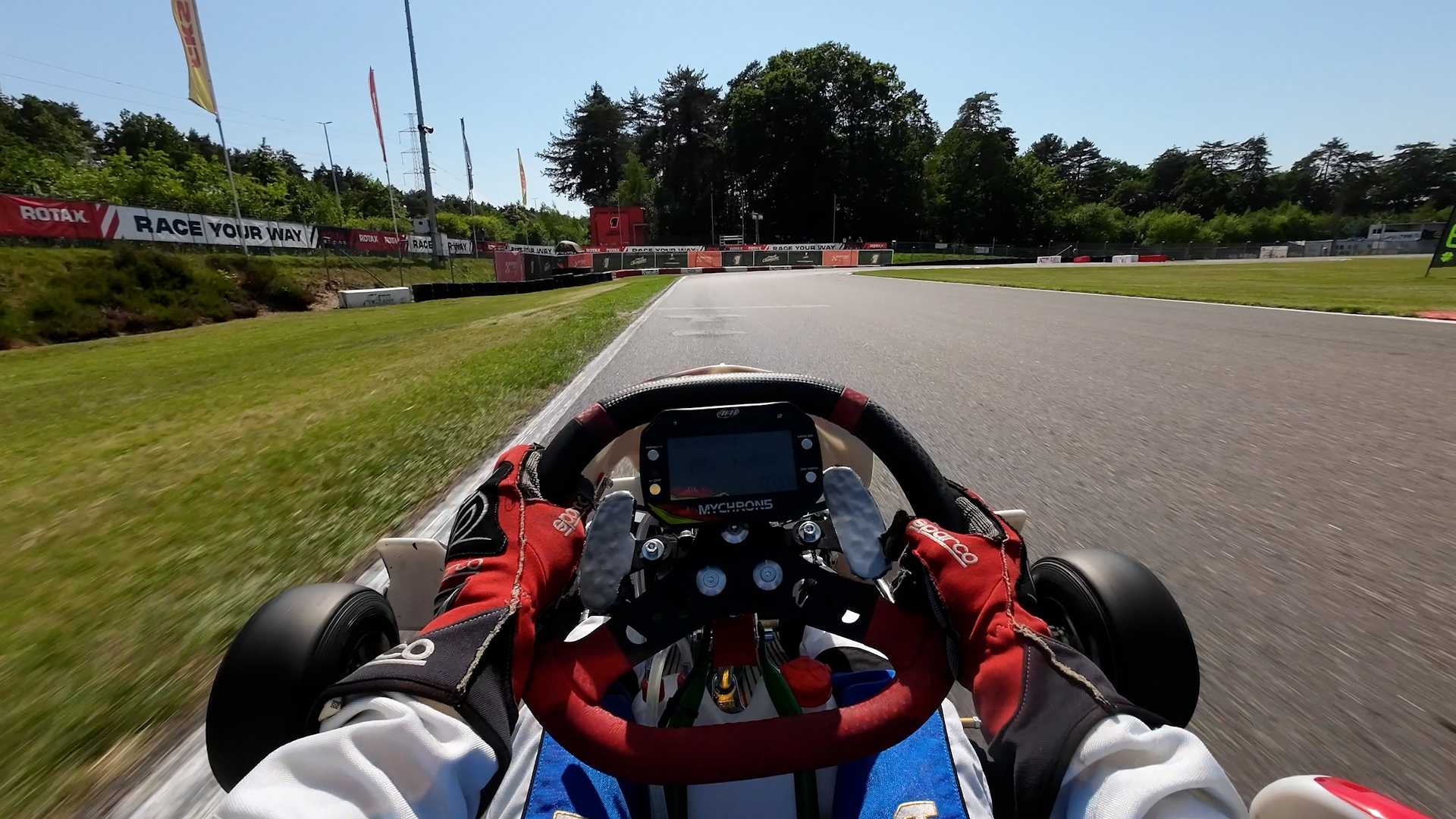
The solution is not to avoid following
Driving with faster drivers is still valuable. Slipstream, reference laps and pack practice all have their place.
The problem starts when those references become a crutch. At some point, you need to replace external references with internal ones: what the limit feels like, what a good corner feels like, and when the kart is about to move past that limit.
That does not happen by memorising one braking marker or copying one lap. Conditions change. Slipstream changes. Tyres change. The driver ahead disappears.
The driver who can keep pace alone is not guessing. They have built a clearer internal model of what fast actually feels like.
Can you still find the limit when nobody is showing it to you?
That question matters because winning often means spending the most important laps without a reference ahead.

Fast alone. Fast when it counts.
The best drivers do not need another kart to tell them they are quick.
They can use a reference when it helps, but they do not collapse when the reference disappears. They know what the limit feels like, and they can keep searching for it even in clean air.
That is why driving fast alone is not just a practice skill. It is a winning skill.
Because if getting to the front makes you slower, the lead does not become freedom. It becomes bait.


